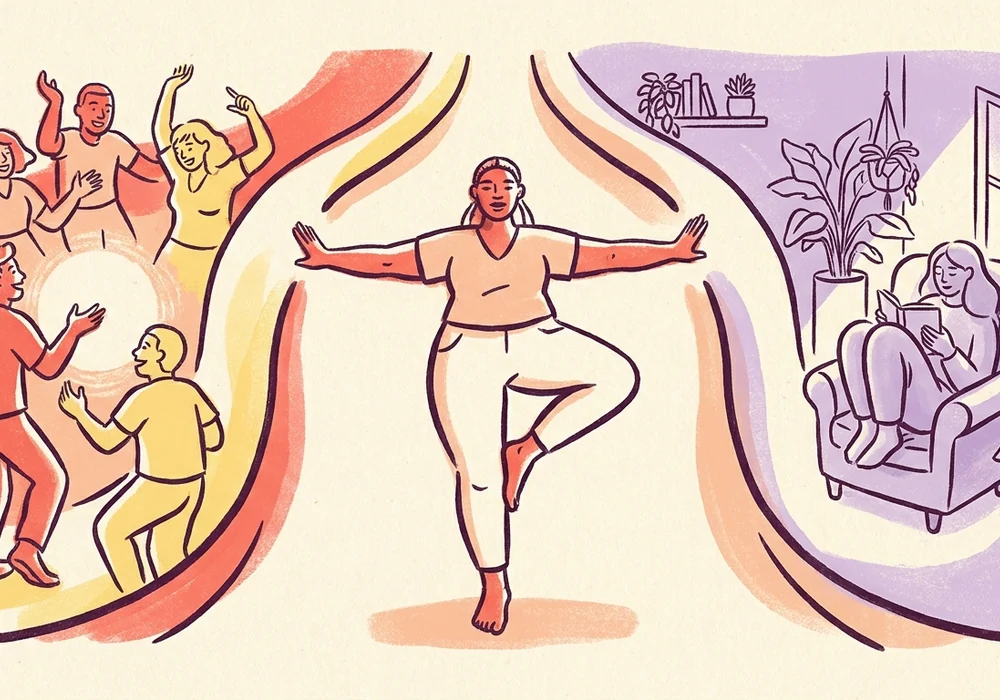
A practical guide to social energy that goes beyond the loud-versus-quiet stereotype.
This guide is part of the Know Yourself collection. For a related perspective, read How to Be More Yourself Around People, or apply the ideas with the Social Battery Planner.
Think energy, not performance
Introversion and extroversion describe broad tendencies in how people respond to stimulation and social contact. They do not measure confidence, kindness, leadership, or conversational skill. A socially skilled person may still need a quiet evening after a busy day; a reserved person may feel restored by a small group they trust.
Ambivert is a useful everyday word for people whose energy shifts noticeably with context. Most people are not located at an extreme, and many act differently at work, with family, and among close friends.
Track the conditions
For one week, note the size of each gathering, how familiar the people were, whether the interaction had a purpose, and your energy before and after. Patterns are more revealing than a single quiz result.
- Small and familiar versus large and unfamiliar
- Structured activity versus open-ended mingling
- Chosen plans versus last-minute obligation
- Depth of conversation versus rapid small talk
Use the pattern
Self-knowledge should improve your choices. Protect a recovery window after demanding events, choose formats that make connection easier, and tell people what helps. You do not need to decline every stretch experience; you need a sustainable rhythm.
A one-week social energy experiment
Record before and after
Rate your energy before an interaction and again thirty minutes afterward; immediate excitement can hide delayed fatigue.
Change one condition
Compare a large gathering with a small one, or an unstructured event with an activity built around a shared purpose.
Plan from the pattern
Protect recovery after the combinations that reliably drain you instead of declining every social stretch.
Example: A one-week social energy experiment
An introvert may enjoy giving a presentation yet need a quiet evening afterward. An extrovert may dislike crowded parties but feel restored by a lively project team. Behavior alone does not reveal the energy cost.
Quick reference
| Signal | More introverted pattern | More extroverted pattern |
|---|---|---|
| After a full social day | Usually seeks low stimulation | Often wants continued contact |
| Best conversation setting | Small, focused, familiar | Varied, active, spontaneous |
| Processing | Often thinks, then speaks | Often thinks by speaking |
Common questions about introvert, extrovert, or ambivert?
Can an introvert enjoy parties?
Yes. Introversion describes a common energy pattern, not dislike of people. An introvert may enjoy a gathering and still need quiet recovery afterward.
Can your social-energy style change by situation?
Yes. Group size, familiarity, stimulation, purpose, and choice can all change how an interaction affects your energy.
Evidence and further reading
These sources provide research context for claims in this guide. A single study does not settle how every person or relationship will respond.
- Pessimistic expectations and poorer experiences: The role of low extraversion in social interaction
A naturalistic study examining extraversion, expected enjoyment, and changes in positive affect after social interaction.
Your social style is a pattern to work with, not a personality verdict.